
The North Carolina Railroad Company (NCRR), in partnership with Norfolk Southern, is replacing up to 69 miles of aging rail between Greensboro and Raleigh as part of a larger investment to modernize North Carolina’s rail infrastructure. This work is one component of the Carolinian and Piedmont Passenger and Freight Improvements (CAPPFI) project and is designed to improve the safety, reliability and long-term performance of one of the state’s busiest rail corridors.
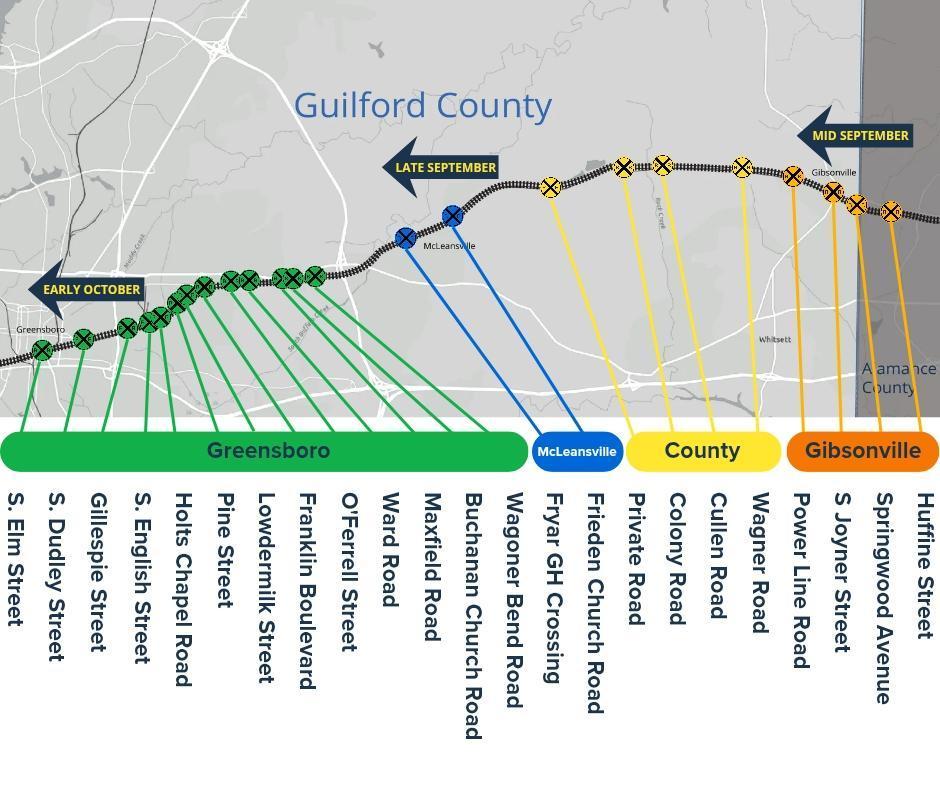
Rail Crossing Road Closures
Frequently Asked Questions
The Carolinian and Piedmont Passenger and Freight Improvements (CAPPFI) rail replacement project is one of nine rail projects funded by the Consolidated Rail Infrastructure and Safety Improvements (CRISI) grant program administered by the Federal Railroad Administration. The grant includes a $105.6 million federal investment into North Carolina’s rail corridor, funding nine distinct rail improvement projects. Other partners investing in strategic projects include the North Carolina Railroad, Norfolk Southern and the North Carolina Department of Transportation, bringing the overall project costs to approximately $170 million. The first project replaces aging rail along portions of the Greensboro-to-Raleigh corridor to improve long-term safety, reliability and performance for both freight and passenger rail.
The North Carolina Railroad corridor produces $247 million in annual tax revenue supported by economic activity along the corridor and more than 15,000 jobs with direct rail-served businesses along the corridor. This project investment strengthens that foundation and represents a major milestone in the state’s infrastructure development, ensuring the continued competitiveness and connectivity of North Carolina’s railways for decades to come.
Rail replacement began in Mebane, the week of Monday, Aug. 24, 2026. Rolling closures are expected on the rail corridor for up to 34 miles between Mebane and Greensboro from late August through September, potentially into October. The remaining section of rail from Efland through Raleigh will occur sometime in 2027. Closure timing Monday through Thursday will vary by location and construction activity.
The North Carolina Railroad Company and Norfolk Southern have stated they will share construction information with local municipalities as the work is mobile and dependent on rail operations. Exact timing may not always be known far in advance. Guilford County will provide regular updates via media outlets, website, and our social media platforms.
The North Carolina Railroad Company (NCRR) is the federal grant recipient and is leading public communications and coordination with municipalities. Norfolk Southern is performing the rail construction work. NCRR is coordinating with Norfolk Southern, the North Carolina Department of Transportation, local governments, emergency responders, schools, and businesses along the corridor to ensure communities receive accurate and consistent information.
NCRR regularly collaborates with government, transportation, and economic partners to invest in growth and consult with communities. This project is a federally funded, railroad-executed, and locally coordinated public-private partnership. NCRR will serve as the communications lead across the partnership, ensuring every stakeholder receives consistent, accurate information.
The project will improve long-term rail infrastructure serving the community and the state. Replacing worn rail helps reduce maintenance-related delays, improves reliability and supports safe, predictable rail operations.
Worn rail can also cause unpredictable failures, which can lead to supply chain delays, unplanned road closures and safety concerns. The addition of new, continuously welded rail eliminates joints and imperfections that cause wear, vibration and risk over time. This will reduce the chance of track failures and crossing incidents. A brief closure now allows crews to install infrastructure intended to serve the corridor for decades.
Commercial and residential access will be maintained through alternate directions, where possible. Some communities will use detours and seek alternate routes, while a select number of communities will be limited in travel, as vehicles, pedestrians, and bicycles will not be able to cross the tracks at closed rail crossings.
For more information about the CAPPFI grant administration and the Rail Replacement Project, contact the North Carolina Railroad Company (NCRR) directly at (919) 954-7601, email info@ncrr.com, or visit NCRR.com/CAPPFI-New-Rail.
For more information on the Rail Replacement construction, email Norfolk Southern at media.relations@nscorp.com.
For emergencies, residents should always call 911.
The North Carolina Railroad Company and partners will identify businesses near affected crossings and provide advance notice where possible.
Notices to businesses will be as specific as possible with directions customers and deliveries can follow to reach the business.
Our transportation partners are working with emergency services providers and school transportation staff by providing crossing-specific closure and detour information.
Guilford County will help share accurate, timely, and localized rail crossing closure and detour information with its residents and stakeholders.
If a closure is extended, the North Carolina Railroad Company and municipal partners will issue an update as soon as possible acknowledging the change, explain what is known, provide revised timing if available and state when the next update will be shared.
Updates will be shared through the Guilford County Rail Project web page, Guilford County social media platforms, and on the North Carolina Railroad Company (NCRR) website.